
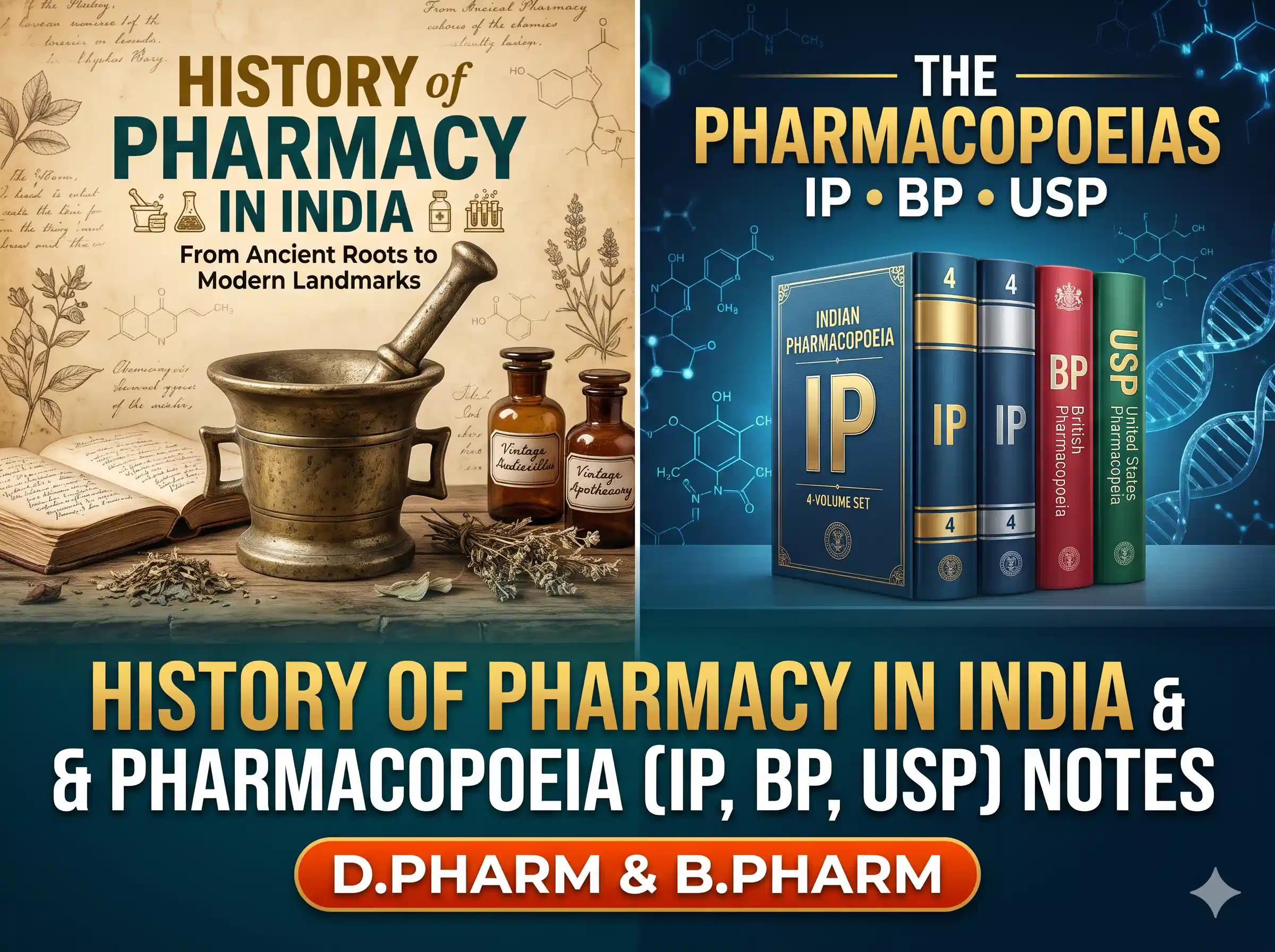
Pharmacy and Pharmacopoeia
Pharmacy is the health science profession that connects medical science with chemistry to prepare, compound, standardize, and dispense safe medicines for patients. The word comes from the Greek word Pharmakon, which means drug or medicine.
Pharmacopoeia is an official, legally recognized book of standards for drugs and medicinal preparations published by the government of a country or a pharmacopoeial authority. The word comes from two Greek words: Pharmakon (drug) and Poiein (to make), meaning a standard guide on how to make and test medicines (History of Pharmacopoeia).
Standard textbook definition
Under the Drugs and Cosmetics Act, 1940, the Indian Pharmacopoeia (IP) is the official book of standards in India that defines the identity, purity, strength, and quality tests for active pharmaceutical ingredients (APIs), dosage forms, and excipients.
Chronological timeline and Indian Pharmacopoeia (IP) editions table
Students often lose marks in exams when dates get mixed up. Use the two revision tables below to memorize the exact years for both one-mark MCQs and ten-mark long answers.
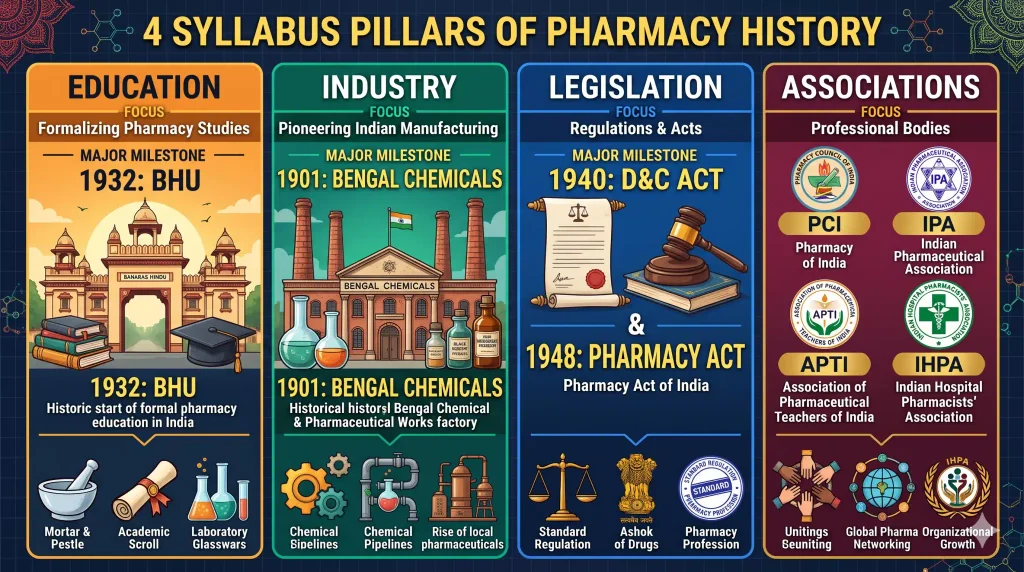
Master timeline of pharmacy profession in India
| Year | Historical Milestone | Key Person / Place / Significance |
|---|---|---|
| 1811 | First chemist shop opened in India | Bathgate and Co. opened in Kolkata (East India Company era) |
| 1842 | First certificate-level pharmacy class | Started at Goa Medical School (History of Pharmacy Education) |
| 1860 | First compounder training class in British India | Started at Madras Medical College to train students in dispensing |
| 1874 | Regular 2-year chemist and druggist diploma | Started at Madras Medical College |
| 1901 | First Indian-owned pharmaceutical company | Bengal Chemical and Pharmaceutical Works founded in Kolkata by Acharya Prafulla Chandra Ray |
| 1907 | Alembic Chemical Works established | Founded in Vadodara (Baroda) by T.K. Gajjar and B.D. Amin |
| 1930 to 1931 | Drugs Enquiry Committee (Chopra Committee) | Appointed by the Government of India under the chairmanship of Col. R.N. Chopra |
| 1932 | Pharmaceutical Chemistry added at university level | Started at Banaras Hindu University (BHU) by Prof. Mahadeva Lal Schroff |
| 1937 | First 3-year B.Pharm degree course in India | Started at BHU by Prof. M.L. Schroff (Father of Indian Pharmacy Education) |
| 1940 | Drugs and Cosmetics Act enacted | Passed to regulate the import, manufacture, distribution, and sale of drugs in India (IP Legal Notice) |
| 1946 | Indian Pharmacopoeial List (IPL) published | Prepared under Col. R.N. Chopra as a supplement to the British Pharmacopoeia (Chapter 1 Pharmaceutics) |
| 1948 | Pharmacy Act passed and IP Committee formed | Pharmacy Act regulated education; Indian Pharmacopoeia Committee formed under Dr. B.N. Ghosh (History of Pharmacopoeia) |
| 1949 | Pharmacy Council of India (PCI) established | First statutory council constituted under the Pharmacy Act, 1948 |
| 1955 | First Edition of Indian Pharmacopoeia (IP) | Published in 1955 under the chairmanship of Dr. B.N. Ghosh |
| 2008 | Pharm.D (Doctor of Pharmacy) introduced | 6-year clinical pharmacy degree notified by PCI |
| 2020 | Education Regulations 2020 (ER-2020) | Updated D.Pharma curriculum introduced by [PCI](https://www.bstpharmacy.in/upload/pdf/1752481240D.%20Pharm%20ER-20%20with%20cover%20page%20(wef%202021-22)(.pdf) |
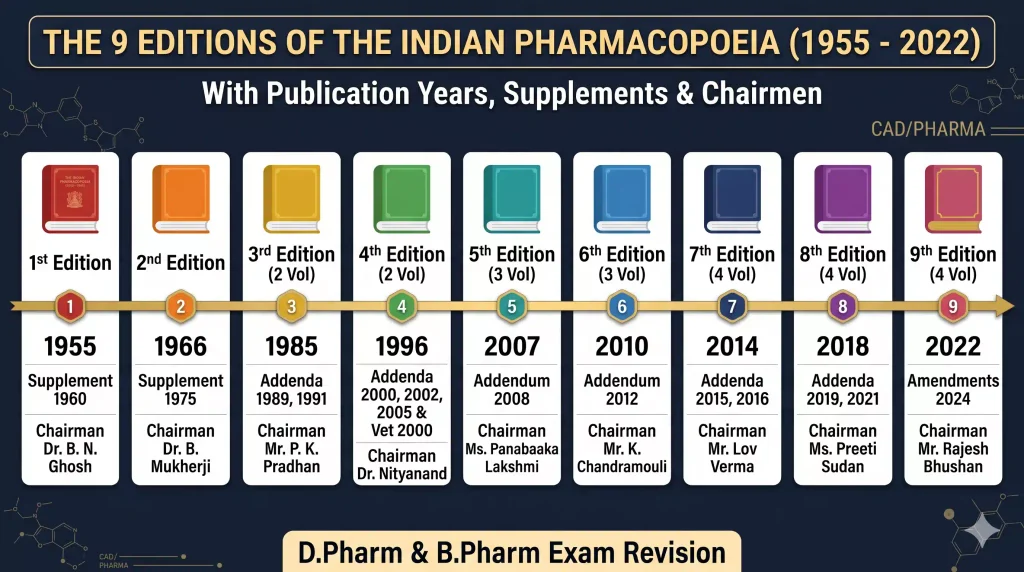
Complete table of Indian Pharmacopoeia (IP) editions (1st to 9th edition)
The Indian Pharmacopoeia Commission (IPC), an autonomous institution under the Ministry of Health and Family Welfare headquartered in Ghaziabad (Uttar Pradesh), publishes and updates the Indian Pharmacopoeia (IP Online).
| IP Edition | Year of Publication | Supplement / Addendum Year | Chairman of IP Committee | Volumes and Key Exam Points |
|---|---|---|---|---|
| 1st Edition | 1955 | 1960 (Supplement) | Dr. B.N. Ghosh | Covered 986 monographs; titles were written in Latin with English abbreviations (History of IP) |
| 2nd Edition | 1966 | 1975 (Supplement) | Dr. B. Mukerji | Monograph titles changed from Latin to English; doses expressed in the metric system (IP 2010 Legal Notice) |
| 3rd Edition | 1985 | 1989, 1991 (Addenda) | Dr. Nityanand | Published in 2 volumes (Volume I: A to P; Volume II: Q to Z and Appendices); introduced microbial limit tests and dissolution testing (Web of Pharma) |
| 4th Edition | 1996 | 2000, 2002, 2005 (Addenda); Vet Supplement (2000) | Dr. Nityanand | Published in 2 volumes; covered 1,149 monographs and 123 appendices; introduced infrared (IR) and UV spectrophotometric tests (History of Pharmacopoeia PDF) |
| 5th Edition | 2007 | 2008 (Addendum) | Dr. Nityanand | Published in 3 volumes by the newly autonomous IPC Ghaziabad (History of Pharmacopoeia PDF) |
| 6th Edition | 2010 | 2012 (Addendum) | Prof. Y.K. Gupta / Scientific Body | Published in 3 volumes; expanded coverage of antiretroviral, herbal, and biotechnology products (IP 2010 Volume 1) |
| 7th Edition | 2014 | 2015, 2016 (Addenda) | Scientific Body, IPC | Published in 4 volumes along with a DVD; incorporated 2,550 monographs (IP Editions Overview) |
| 8th Edition | 2018 | 2019, 2021 (Addenda) | Scientific Body, IPC | Published in 4 volumes (orange cover); added 220 new monographs and replaced several animal toxicity tests with in-vitro methods (Overview of Major Pharmacopoeias) |
| 9th Edition | 2022 | 2024 (Addendum) | Scientific Body, IPC | Published in 4 volumes on 1 July 2022; added 92 new monographs (totaling over 3,152 monographs) including COVID-19 therapeutics, vaccines, and vitamins (IP 2022 Overview) |
Comparison of IP, BP, USP, and Extra Pharmacopoeia (Martindale)
| Compendium Name | Country / Scope | First Published | Published By | Compendium Type |
|---|---|---|---|---|
| Indian Pharmacopoeia (IP) | India | 1955 | Indian Pharmacopoeia Commission (IPC), Ghaziabad | Official Compendium |
| British Pharmacopoeia (BP) | United Kingdom (used in 100+ countries) | 1864 | British Pharmacopoeia Commission (MHRA, UK) | Official Compendium |
| United States Pharmacopeia (USP) | United States | 1820 | United States Pharmacopeial Convention | Official Compendium (Merged with NF as USP-NF in 1980) |
| National Formulary (NF) | United States (Excipients focus) | 1888 | American Pharmaceutical Association (now USP Convention) | Official Compendium |
| Extra Pharmacopoeia (Martindale) | International Reference | 1883 | Royal Pharmaceutical Society of Great Britain (Pharmaceutical Press) | Non-Official (Secondary) Reference Book |
History of profession of pharmacy in India: Point-wise notes
In semester exams, a 10-mark question usually asks you to describe the history of pharmacy in India in relation to education, industry, practice, and professional associations (D.Pharm ER-2020 Syllabus. Write your answer under the five headings below.
1. History of pharmacy education in India
- Early colonial classes (1842 and 1860): Basic pharmacy training began in 1842 at the Goa Medical School under Portuguese rule (History of Pharmacy Profession). In British India, the first compounder training class started in 1860 at Madras Medical College, followed by a regular two-year Chemist and Druggist diploma there in 1874.
- Compounder training in Bengal (1881): Formal compounder training began in Bengal in 1881 at Campbell Medical School, Kolkata.
- University-level degree at BHU (1932 and 1937): Prof. Mahadeva Lal Schroff (1902 to 1971), known as the Father of Pharmacy Education in India, introduced Pharmaceutical Chemistry as a subject in B.Sc. at Banaras Hindu University (BHU) in 1932 (Textbook of Pharmaceutics-I). In 1937, he started India’s first three-year Bachelor of Pharmacy (B.Pharm) degree at BHU.
- First postgraduate and pharmacology programs (1940 to 1947): BHU introduced the first M.Pharm program in 1940 (Textbook of Pharmaceutics-I). In 1944, Panjab University (Lahore) started a B.Pharm course concentrating on Pharmacognosy and Pharmacology, and in 1947, L.M. College of Pharmacy (LMCP), Ahmedabad was founded as the first standalone degree pharmacy college in India.
- Standardization under PCI (1948 to 2020): The Pharmacy Act, 1948 established the Pharmacy Council of India (PCI) in 1949 to enforce uniform Education Regulations (ER) for the Diploma in Pharmacy (D.Pharm). PCI introduced the 6-year clinical Pharm.D program in 2008 and revised the D.Pharm curriculum under ER-2020 (PCI ER-2020 Syllabus.
2. History of pharmaceutical industry in India
- Colonial trading and apothecary phase (1811 to 1900): During the 19th century, India imported most finished medicines from Britain. Bathgate and Co. opened the first chemist shop in Kolkata in 1811, and Smith Stanistreet and Co. started operations in 1821 (History of Pharmacy Profession).
- Swadeshi pharmaceutical industry (1901 to 1939): In 1901, Acharya Prafulla Chandra Ray founded Bengal Chemical and Pharmaceutical Works Ltd. in Kolkata (originally started as a small laboratory in 1892), establishing India’s first indigenous pharmaceutical factory. Soon after, Prof. T.K. Gajjar and B.D. Amin started Alembic Chemical Works in Vadodara in 1907, and Bengal Immunity was established in 1919.
- Public sector bulk drug units after Independence (1947 to 1969): With technical support from WHO and UNICEF, the Government of India set up Hindustan Antibiotics Limited (HAL) at Pimpri (Pune) in 1954 and Indian Drugs and Pharmaceuticals Limited (IDPL) in 1961 to manufacture penicillin, streptomycin, and synthetic bulk drugs domestically.
- Process Patent Act and Generic Boom (1970 to Present): The Indian Patents Act, 1970 recognized process patents instead of product patents for medicines. This allowed Indian companies (such as Cipla, Ranbaxy, Dr. Reddy’s Laboratories, Lupin, and Sun Pharma) to develop cost-effective manufacturing processes for essential drugs, turning India into the largest global supplier of affordable generic medicines and vaccines.
3. History of pharmacy practice and legislation in India
- Drugs Enquiry Committee (Chopra Committee, 1930 to 1931): Widespread dumping of substandard and adulterated foreign drugs in India after World War I led the government to appoint the Drugs Enquiry Committee in 1930 under the chairmanship of Col. Ram Nath Chopra (Chapter 1 Pharmaceutics). The committee submitted its report in 1931 with 90 recommendations for central drug legislation, pharmacist registration, and compilation of a national pharmacopoeia.
- Drugs and Cosmetics Act (1940) and Rules (1945): Based on the Chopra Committee report, the Drugs Act was passed in 1940 (later titled the Drugs and Cosmetics Act, 1940) along with the Drugs Rules in 1945 to control the quality of imported and domestically manufactured medicines (IP 2010 Legal Notice).
- Pharmacy Act (1948): Enacted on 4 March 1948 to regulate the profession and practice of pharmacy through Central and State Pharmacy Councils, ensuring that only registered pharmacists dispense prescription medicines (Pharmacy Council of India).
- Other key pharmaceutical acts:
- Drugs and Magic Remedies (Objectionable Advertisements) Act, 1954: Prohibits misleading advertisements claiming magical cures (Chapter 1 Pharmaceutics).
- Medicinal and Toilet Preparations (Excise Duties) Act, 1955: Enforces uniform excise duty on medicinal products containing alcohol or narcotics (Chapter 1 Pharmaceutics).
- Narcotic Drugs and Psychotropic Substances (NDPS) Act, 1985: Controls the manufacture, possession, and sale of habit-forming narcotic and psychotropic drugs (Chapter 1 Pharmaceutics).
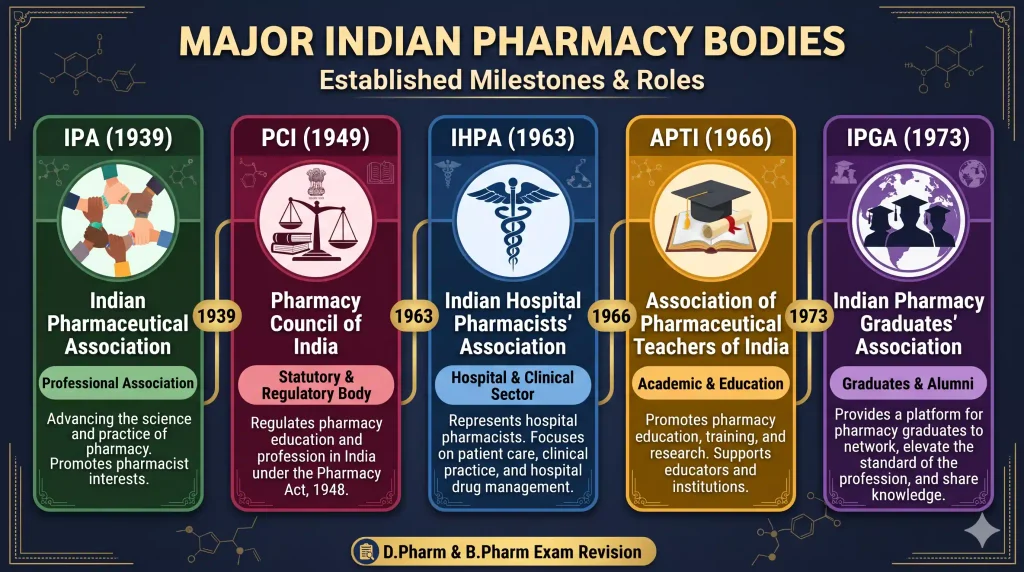
4. Professional pharmacy associations in India
- Indian Pharmaceutical Association (IPA): Initially started as the Banaras Hindu University Pharmaceutical Association in 1935 and reorganized as the national Indian Pharmaceutical Association (IPA) in 1939 by Prof. M.L. Schroff. It publishes the Indian Journal of Pharmaceutical Sciences (IJPS) and organizes National Pharmacy Week every November (Prof. M.L. Schroff Biography).
- Pharmacy Council of India (PCI, 1949): The statutory body under the Ministry of Health and Family Welfare that approves pharmacy colleges, prescribes Education Regulations, and maintains the Central Register of Pharmacists (PCI Official).
- Indian Hospital Pharmacists Association (IHPA, 1963): Founded in 1963 in New Delhi by Prof. B.D. Miglani to advance hospital and clinical pharmacy practice.
- Association of Pharmaceutical Teachers of India (APTI, 1966): Established in 1966 by Prof. M.L. Schroff and Prof. G.P. Srivastava to connect pharmacy educators and improve teaching standards across Indian universities.
- Indian Pharmacy Graduates’ Association (IPGA, 1973): Formed in 1973 to represent pharmacy graduates and promote professional standards in industry, regulatory control, and community practice.
5. Detailed notes on Pharmacopoeias (IP, BP, USP, NF, and Martindale)
A. Indian Pharmacopoeia (IP)
- Pre-Independence Background: During British rule, the British Pharmacopoeia (BP) was used in India. In 1946, the Government of India published the Indian Pharmacopoeial List (IPL) under the chairmanship of Col. R.N. Chopra. The IPL listed indigenous Indian medicinal plants and drugs that were not included in the BP (Chapter 1 Pharmaceutics).
- Post-Independence Constitution (1948): In 1948, the Government of India constituted a permanent Indian Pharmacopoeia Committee under the chairmanship of Dr. B.N. Ghosh (IP Online History).
- First to Ninth Editions (1955 to 2022): The 1st edition was published in 1955, followed by the 2nd (1966), 3rd (1985), 4th (1996), 5th (2007), 6th (2010), 7th (2014), 8th (2018), and 9th edition (2022) (History of Pharmacopoeia PDF). Since 2005, the Indian Pharmacopoeia Commission (IPC) in Ghaziabad serves as the autonomous body preparing and publishing the IP.
B. British Pharmacopoeia (BP)
- Origin (1864): Earlier, England, Scotland, and Ireland had separate pharmacopoeias: the London Pharmacopoeia (1618), Edinburgh Pharmacopoeia (1699), and Dublin Pharmacopoeia (1807). Under the Medical Act of 1858, the General Medical Council merged all three to publish the first edition of the British Pharmacopoeia (BP) in 1864 (Pharmacopoeia Analysis).
- Current Status: Published annually by the British Pharmacopoeia Commission (part of the Medicines and Healthcare products Regulatory Agency, MHRA, UK). It includes six volumes covering medicinal substances, formulated preparations, herbal drugs, blood products, immunological products, and the British Pharmacopoeia (Veterinary).
- British Pharmaceutical Codex (BPC): First published in 1907 by the Pharmaceutical Society of Great Britain to provide standards and dispensing information for drugs not included in the BP (Pharmacopoeia Analysis).
C. United States Pharmacopeia (USP) and National Formulary (NF)
- First Edition of USP (1820): Initiated by physician Dr. Lyman Spalding, the first edition of the United States Pharmacopeia was published on 15 December 1820 in both English and Latin (Indian Pharmacopoeia Slideshare).
- National Formulary (NF, 1888): First published in 1888 by the American Pharmaceutical Association (APhA). While USP focuses on active drug substances and dosage forms, NF focuses on pharmaceutical excipients (pharmaceutical aids) (Introduction to Pharmacopoeias).
- Combined USP-NF (1980): In 1975, the United States Pharmacopeial Convention purchased the NF, and since 1980 both have been published together in a single combined book called USP-NF (Introduction to Pharmacopoeias).
D. Extra Pharmacopoeia (Martindale)
- Origin (1883): First published in 1883 by British pharmacist William Martindale and physician W. Wynn Westcott under the title Martindale: The Extra Pharmacopoeia (Introduction to Pharmacopoeias).
- Publisher and Purpose: Published by the Pharmaceutical Press (the publishing arm of the Royal Pharmaceutical Society of Great Britain) (Martindale 31st Edition). Since 1999 (32nd edition), it is titled Martindale: The Complete Drug Reference.
- Why It Is Non-Official: Unlike IP, BP, or USP, Martindale does not set legal regulatory testing limits for a single country. Instead, it is an international secondary reference encyclopedia giving clinical uses, dosages, adverse effects, and proprietary brand names for over 6,000 drugs and herbal medicines used worldwide (Introduction to Pharmacopoeias).
Importance and limitations of pharmacopoeias
Importance (Advantages) of Official Pharmacopoeias
- Uniform Drug Quality: Guarantees that a tablet or injection of a medicine contains the exact labeled strength and meets purity standards regardless of which company manufactures it.
- Control of Adulteration and Impurity: Provides official chemical, physical, chromatographic (HPLC/GC), and microbiological tests to detect impurities, heavy metals, and counterfeit drugs.
- Legal Enforcement Benchmark: Acts as the statutory reference book for Drug Inspectors and Government Analysts testing market samples under the Drugs and Cosmetics Act, 1940 (IP 2010 Volume 1).
- Guidance for Formulation Scientists: Supplies standard test procedures for dissolution, disintegration, friability, and sterility during generic drug development.
- International Export Harmonization: Aligning Indian Pharmacopoeia monographs with BP, USP, and the Pharmacopoeial Discussion Group (PDG) helps Indian manufacturers export medicines globally (IP Online).
Limitations of Official Pharmacopoeias
- Time Lag for New Molecules: Newly approved drugs or novel delivery systems may take several months or years before a full monograph appears in the next edition or addendum.
- Limited Clinical and Prescribing Detail: Official pharmacopoeias focus on quality control, assay, and purity standards rather than detailed clinical pharmacology, drug interactions, or patient counseling (which require non-official compendia like Martindale).
- High Cost of Analytical Instruments: Modern pharmacopoeial monographs often require advanced instruments (such as HPLC, GC-MS, or FTIR), which small testing laboratories may find expensive to maintain.
- Variation Across National Standards: Assay limits or dissolution media for the same drug can differ slightly between IP, BP, and USP, requiring separate validation batches for export markets.
Most expected semester exam questions
Short answer questions (2 to 3 marks)
- Differentiate between the Indian Pharmacopoeial List (1946) and the Indian Pharmacopoeia (1955).
- Answer tip: State that the IPL (1946) was a pre-independence supplement to the British Pharmacopoeia chaired by Col. R.N. Chopra, whereas the IP (1955) was independent India’s first official book of drug standards chaired by Dr. B.N. Ghosh.
- Write a short note on Martindale: The Extra Pharmacopoeia.
- Answer tip: Mention its founder (William Martindale, 1883), publisher (Royal Pharmaceutical Society of Great Britain), non-official status, and use as a global clinical reference for drugs and proprietary medicines.
- Why is Prof. Mahadeva Lal Schroff called the Father of Pharmacy Education in India?
- Answer tip: Mention his introduction of Pharmaceutical Chemistry (1932) and the first 3-year B.Pharm course (1937) at BHU, founding of the Indian Pharmaceutical Association (1939) and APTI (1966), and service as President of PCI.
Long answer questions (5 to 10 marks)
- Describe the history of the profession of pharmacy in India in relation to pharmacy education, pharmaceutical industry, and professional associations. (10 Marks)
- Answer tip: Start with the Master Timeline table, then write 4 to 5 bullet points each under Education (1842 Goa, 1860 Madras, 1937 BHU, 1948 Pharmacy Act), Industry (1901 Bengal Chemicals, 1907 Alembic, 1954 HAL, 1970 Patents Act), and Associations (IPA, PCI, IHPA, APTI).
- Define Pharmacopoeia. Give a detailed account of all editions of the Indian Pharmacopoeia (IP) and write brief notes on BP and USP. (10 Marks)
- Answer tip: Write the etymology (Pharmakon + Poiein), draw the 9-edition IP table (1955 to 2022) with chairmen and supplement years, and add 4 points each on BP (1864) and USP-NF (1820/1888).
Quick practice MCQs on history of pharmacy and pharmacopoeia
Q1. Who is known as the Father of Pharmacy Education in India?
- A) Acharya Prafulla Chandra Ray
- B) Col. R.N. Chopra
- C) Prof. Mahadeva Lal Schroff
- D) Dr. B.N. Ghosh
- Answer: C) Prof. Mahadeva Lal Schroff (He started the first 3-year B.Pharm degree course at Banaras Hindu University in 1937.)
Q2. The First Edition of the Indian Pharmacopoeia (IP) was published in which year and under whose chairmanship?
- A) 1946, Col. R.N. Chopra
- B) 1948, Prof. M.L. Schroff
- C) 1955, Dr. B.N. Ghosh
- D) 1966, Dr. B. Mukerji
- Answer: C) 1955, Dr. B.N. Ghosh (Note: 1946 under Col. R.N. Chopra was the Indian Pharmacopoeial List, while the 1st edition of IP was published in 1955 under Dr. B.N. Ghosh.)
Q3. India’s first indigenous pharmaceutical company, Bengal Chemical and Pharmaceutical Works, was established in 1901 by:
- A) T.K. Gajjar
- B) Acharya Prafulla Chandra Ray
- C) Dr. Nityanand
- D) Khwaja Abdul Hamied
- Answer: B) Acharya Prafulla Chandra Ray (Established in Kolkata in 1901 after beginning as a small laboratory in 1892.)
Q4. In which edition of the Indian Pharmacopoeia were monograph titles changed from Latin to English?
- A) 1st Edition (1955)
- B) 2nd Edition (1966)
- C) 3rd Edition (1985)
- D) 4th Edition (1996)
- Answer: B) 2nd Edition (1966) (Chaired by Dr. B. Mukerji, the 2nd edition shifted monograph titles from Latin to English and adopted the metric system for doses.)
Q5. Martindale (The Extra Pharmacopoeia) was first published in which year?
- A) 1820
- B) 1864
- C) 1883
- D) 1907
- Answer: C) 1883 (1820 is USP, 1864 is BP, 1883 is Martindale Extra Pharmacopoeia, and 1907 is the British Pharmaceutical Codex.)
[CTA Button for WordPress]:Ready for Exam Practice? [Attempt the Full Quiz: Top 25 MCQs on History of Pharmacy and Indian Pharmacopoeia (With Explanations) -> (Day 2 Post Link)]





Leave a Reply